
Sumter County Arrest to Court Records
After a person is booked into Sumter County Jail, the booking record and the later court record serve different purposes. The InteropWeb jail roster can show the arrest date, arresting agency, charge description, statute, warrant number, misdemeanor or felony marker, bond, and a court field such as State Court or Superior Court. That is a strong starting point, but it is still a jail record. It reflects what was entered during booking or detention, not the final charging decision.
The court side begins when prosecutors and clerks process a formal case. Sumter County is in the Southwestern Judicial Circuit, and the District Attorney is Lewis R. Lamb. Felony matters usually route to Superior Court, while many misdemeanor matters can route to State Court. The GSCCCA Sumter County clerk profile lists Cortisa E. Barthell as Clerk of Superior Court and identifies Superior and State as managed courts. For custody details, use Sumter County jail inmate records. For booking photos, use Sumter County jail roster mugshots. The court record is the better source for filed charges, hearings, dispositions, and whether a charge ended in conviction.
Find Court Records After Arrest
Georgia Courts provides an e-access court records page that links Sumter State and Sumter Superior to PeachCourt. Georgia Courts warns that users are redirected to a provider site and may need an account to search. That means the state e-access page is the correct doorway, but PeachCourt controls the search session, account access, and any provider-side screens.
The roster is useful before searching court records because Sumter County charge rows can include the court, statute, warrant number, and charge level. If the court field says Superior Court, start with Sumter Superior. If the field says State Court, start with Sumter State. If no court is listed, the booking may be too new, the field may be blank, or the charge may still be waiting for formal filing.
- Open the Georgia Courts e-access page and choose the Sumter State or Sumter Superior PeachCourt link.
- Use the defendant name from the jail roster. Try partial names if punctuation or spelling varies.
- Compare the court case to the roster charge by arrest date, statute, warrant number, agency, and charge description.
- Read each charge line for its current status, next court event, and disposition if one has been entered.
- Call the Clerk of Superior Court criminal contacts if the case does not appear but the jail entry points to State or Superior Court.
| Field Label | Type | Required | Options / Format Notes |
|---|---|---|---|
| Sumter State | Link | No | Georgia Courts e-access link to PeachCourt for State Court records. |
| Sumter Superior | Link | No | Georgia Courts e-access link to PeachCourt for Superior Court records. |
| Provider account/login | Account | Yes for provider search | Georgia Courts states that a provider account may be required. |
| Defendant name / case number | Search fields | Provider controlled | Exact PeachCourt form fields were not fully visible in the research capture. |
The Georgia Courts e-access capture shows Sumter court links routed to PeachCourt.
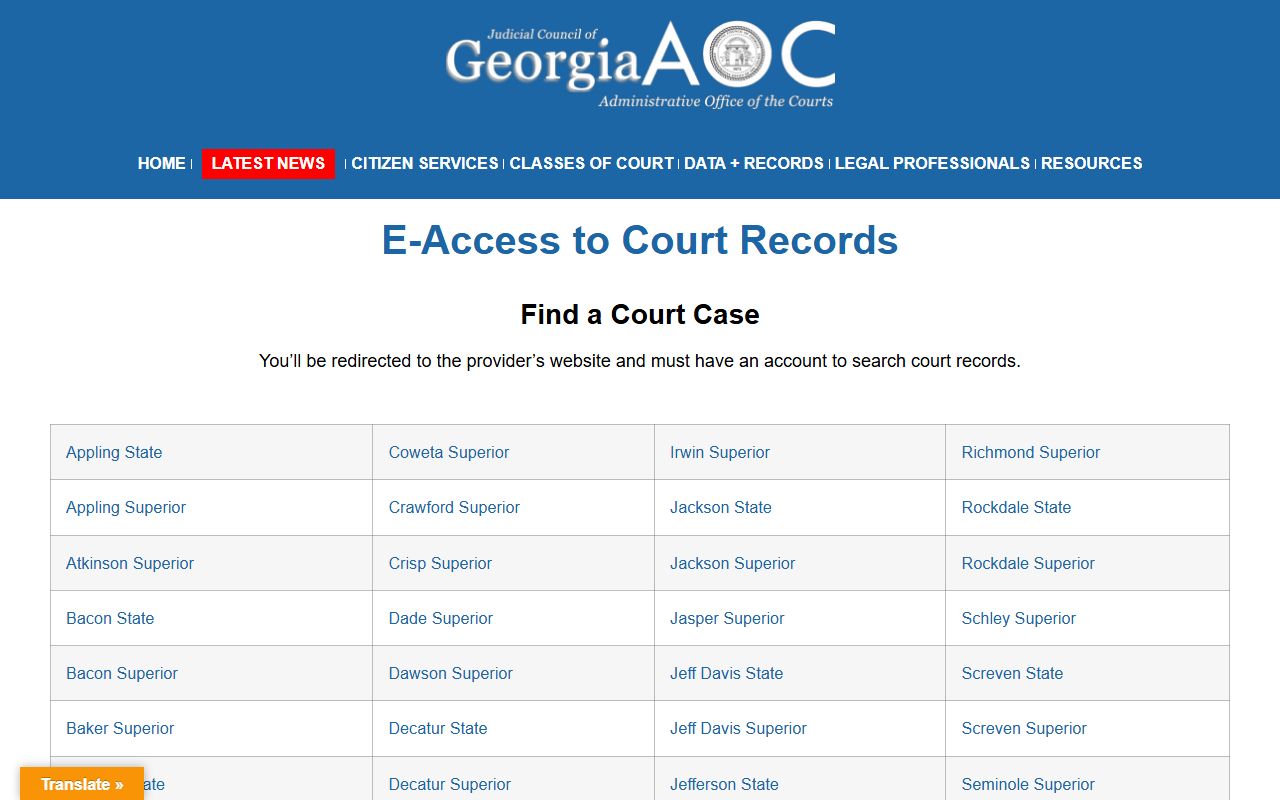
The screenshot matters because Sumter County court records after arrest are not searched through the jail roster alone. The court provider is the channel for filed State Court and Superior Court case records.
Sumter Court and Clerk Contacts
The Clerk of Superior Court is the practical contact point when a PeachCourt search does not answer whether charges have been filed. The GSCCCA clerk profile lists the office at 500 W. Lamar St., P.O. Box 333, Americus, GA 31709. The main phone is (229) 928-4537, the fax is (229) 928-4539, and posted hours are 9:00am to 5:00pm Monday through Friday. Criminal staff contacts named in the research are Leigh Hudson and Jessika Woods for Superior Court Criminal, and Miranda Arnold and Jasmine Sims for State Court Criminal.
Copy fees are also a clerk issue. The GSCCCA and county FAQ material list copies at $1 per page, certified copies at $2.50 for the first page plus $0.50 for each added page, and faxes at $2.50 for the first page plus $1 for each added page. Fees can change. Ask the clerk for the current total before ordering certified court records after a jail arrest.
Sumter County Clerk of Superior Court
500 W. Lamar St., P.O. Box 333
Americus, GA 31709
(229) 928-4537
Monday-Friday, 9:00am-5:00pm
Southwestern Judicial Circuit District Attorney
P.O. Box 1328
Americus, GA 31709
(229) 924-5411
Monday-Friday, 8:30 a.m.-5 p.m.
Charging Documents After Arrest
A charging document is the paper or electronic filing that turns an allegation into a court case. In Sumter County, the jail roster may show a statute and a court marker first. The prosecutor then decides what to file, amend, reduce, dismiss, or present for indictment. A booking line can therefore be broader, rougher, or earlier than the later court charge.
| Document | Who Uses It | What It Does | Why It Matters |
|---|---|---|---|
| Warrant or accusation reference | Law enforcement / court | Supports arrest, detention, or a listed charge row. | The roster has a Warrant# column that can help match jail and court records. |
| Accusation / information | Prosecutor | States charges selected for prosecution without a grand jury indictment. | The filed charge may differ from the booking label. |
| Indictment | Grand jury | Formal felony charging document after grand jury action. | Serious felony matters may move from arrest charge to indictment. |
| Disposition order | Court | Records plea, verdict, dismissal, sentence, or other outcome. | This is where charge status becomes clearer than the jail roster. |
Charge Status After Arrest
Charge status can change several times. A person can be booked on one description, appear in court under another, and later have counts amended, reduced, dismissed, or resolved by plea. A court record after arrest should be read by charge line, not just by the case title. The Sumter County jail roster helps with the first match because it shows statute, count, charge description, M/F marker, and court when entered.
| Status | Plain Meaning | What to Check |
|---|---|---|
| Pending | The charge is open and no final disposition is shown. | Next hearing, bond order, and any amended filing. |
| Amended | The prosecutor or court changed the charge wording, count, or level. | Compare the filed charge to the original jail roster charge. |
| Reduced | The charge moved to a lower level or lesser offense. | Look for plea terms, amended accusation, or court order. |
| Dismissed / nolle prosequi | The state is not proceeding on that charge in that case. | Confirm whether other counts, warrants, or cases remain open. |
| Convicted | A plea or verdict resulted in guilt on that charge or a lesser charge. | Sentence, probation terms, fines, and appeal status. |
Note: A jail charge is an accusation tied to custody; a conviction is a court outcome after plea or verdict.
Bond Changes in Court
Bond is another place where the jail record and court record can diverge. InteropWeb shows a Total Bond field, with examples ranging from numeric totals to NOT SET. Georgia bond law is in O.C.G.A. Title 17, Chapter 6, Article 1. A first appearance, later bond hearing, probation issue, parole issue, child-support warrant, or outside hold can change whether release is possible.
| Bond Type | How It Works | Sumter County Search Tip |
|---|---|---|
| Cash bond | Money is posted directly, subject to court handling. | Call the jail before payment because the roster total may not show all holds. |
| Surety bond | A licensed bonding company posts bond for the defendant. | Confirm that the charge is bondable and no court hold blocks release. |
| Recognizance / PR | Release is based on a promise to appear and comply with conditions. | Look for court orders, not only the roster bond field. |
| No bond / NOT SET | No release amount is listed or a judge must act first. | Check for probation, parole, FTA, child-support, federal, ICE, or outside-agency holds. |
Warrants in Court Records
Sumter County research did not locate a separate official active-warrant search page on the sheriff's website or court website. After arrest, the jail roster can still give warrant clues because charge rows include a Warrant# column. Examples in the research included failure-to-appear, probation violation, parole violation, child-support, and other warrant-like references. Those records should be checked against the court case when the warrant came from State Court, Superior Court, or another issuing court.
For warrant routing, use the Sumter County Sheriff's Office at (229) 924-4094, the court clerk for State or Superior case context, and the issuing court if the issue came from a lower or municipal matter. The Sumter County Sheriff's Office iOS app also advertises Most Wanted and inmate search, though the research did not locate a matching official web warrant database.
Charges Versus Convictions
A court record after a Sumter County jail arrest should not be read as a conviction unless the case record shows a plea, verdict, or other final adjudication. The distinction is important for employers, landlords, licensing bodies, family members, and victims who are trying to understand what happened in the case. The roster may show an arrest charge, but the court record controls the filed charge and the outcome.
| Point | Charge | Conviction |
|---|---|---|
| Stage | Allegation after arrest or formal filing. | Final result after plea, verdict, or adjudication. |
| Proof | Based on arrest, warrant, accusation, or indictment standards. | Based on plea or proof beyond a reasonable doubt. |
| Where found | Roster and court filings. | Court disposition and sentencing records. |
| Can change | Yes, charges can be amended, reduced, added, or dismissed. | Later changes require court action, appeal, restriction, or other legal process. |
Restricted and Sealed Records
Georgia does not use the word expungement in the same casual way many searchers use it. The main state concept is record restriction. O.C.G.A. § 35-3-37 covers restriction of certain criminal-history records, including some arrest records and associated fingerprints or photographs, depending on disposition and eligibility. A dismissed charge, no-bill, or other eligible result may be treated differently from a conviction.
| Term | Georgia Context | Practical Effect |
|---|---|---|
| Restricted | Access to eligible criminal-history information is limited under Georgia law. | Public access may be reduced, but not every agency use disappears. |
| Sealed | Court access may be limited by law or court order. | The public may not see parts of a case record. |
| Expunged | Often used by the public as shorthand, but Georgia commonly uses restriction. | Do not assume destruction of all records unless a specific order or statute says so. |
| Juvenile / protected matter | Some records are not public or are handled under special rules. | Clerk staff may confirm process but may not release protected details. |
Public Access Limits
Georgia's Open Records Act favors access to public records. O.C.G.A. § 50-18-70 defines public records broadly, and O.C.G.A. § 50-18-71 gives agencies a reasonable time, not more than three business days, to produce available records or explain timing. Fees may include copies and certain search, retrieval, or redaction costs.
Public access does not mean every court or jail item is online. Some records may require a clerk request, some may be restricted, and some may still be pending entry. Booking photographs have a separate Georgia rule in O.C.G.A. § 35-1-19, especially when a requester intends to republish the photo on a site that charges for removal. Court records after a jail arrest should therefore be verified with the originating court or agency before anyone relies on them for a serious decision.
Important: This privately run resource is not a consumer reporting agency and must not be used for FCRA-covered screening.